Friday, September 30, 2011

Media Literacy in Civics

"However we define it, we must agree that today's students, our future citizens, should be able to marshal thinking skills to spot 'eye-witless news... a twinkle of the airwaves' (Bennett, 2001) or 'manufactured news' (Postman, 1992) if they are to reason intelligently about societal issues and draw meaningful conclusions about political candidates."

What this is saying is that students today need to be able to think critically and to be able to analyze things so that they can become good citizens when they become adults. So many students even at the college level, if they were asked to take the citizenship exam, they would fail and fail miserably, yet immigrants can pass it to become citizens. Students today just do not care about the country that is provided for them and they need to start becoming more educated so that they can contribute to society and be informed voters. Teaching media literacy will allow students to be able to break down different pieces of media and interpret them and be informed from them.


This shows just how the majority of the upcoming generation are; they really don't care who gets the presidency so they don't pay attention to anything about them.

Citations

Abilock, D. (2003, November/December). A seven-power lens on 21st century literacy .


http://standupforamerica.wordpress.com/2010/03/22/is-voting-a-right-should-it-be-regulated/

Media Literacy Photo Analysis

In the first photo we see Obama meeting with a group of people and it can be assumed that they are talking about matters of the coast cause otherwise they wouldn't be there. It also represents that this meeting is not formal but semi-casual and we know this through what the men are wearing, and then Obama is trying to make a statement that he is there to help and he doesn't want the people thinking he his a coward which is why he lowers the number of Secret Service. The caption and title raise questions, though, like what does it mean when the President is taking claims, and who is he taking them from. It also raises the question of is he really ready to let the government take care of the oil spill.

In the second picture Obama looks puzzled, and the logical explanation is that he is in deep thought. It also says to me that he is trying to think of ways to aid in the oil spill or stop it all together. However it could mean that he is disgusted with BP for not cleaning up the spill faster. The title and caption raise the question that maybe he is thinking about ways to get out of this tarnishing his legacy as a President but while still helping out the gulf. It also raises the question of is he mad that this is happening in his presidency.

Friday, September 23, 2011

Art as an key component of Education

"The Language of art has become the next literacy-or the fourth R. We need not linger any longer over whether art should have a permanent and central place in our school curriculum. It should, and we need to move quickly to prepare students to be literate in the world that they are inheriting and rapidly shaping. In the digital age, art skills are not just good for the soul, but they provide, in the words of Elliot Eisner (1988), 'access to cultural capital,' and ultimately, access to employment."

I chose this quote because while it does have a good message and probably has some truth to it; I just don't see how putting so much attention on art is a good thing. While using technology and digital stories is a good thing and art is used in the digital stories, I believe that is really the extent of what the average person will be using art for. I am studying to be a Social Studies Teacher and so I know that art is used a lot to try to help us understand a group of people or a time period in history, but I just don't think it is more significant than the other three R.


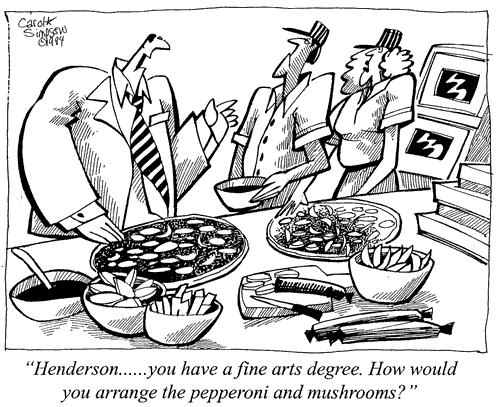
I chose this cartoon picture because it satirically speaks to my point about art not being as important as the other R. This cartoon shows the unimportannce of art to the point where the boss doesn't even know the difference between a fine arts degree and an art degree.

                                                                             Works Cited
Ohler, J. (2000, October). Art becomes the next r. Educational Leadership Magazine,58(2), 16-             19. Retrieved from https://docs.google.com/document/d/1vCKbHYY-gzXtLXnLak8i_hoV7TPAOfxNIamNrkWW3Pc/edit


http://www.toonpool.com/cartoons/Fear%20No%20Art_47330

Digital Stories and Relation to Education

Digital stories are a great tool for teachers and school systems to use in the classroom. It presents many different positive ways for students to learn, plus it gives them good exposure to technology. Jason Ohler says it well when he says, "Such technologies give voice to a number of otherwise quiet students and to students who skills don't fit the usual academic mold" (Ohler, 2005). What this is saying is that digital stories help kids who have trouble learning to learn better. In a Social Studies classroom, a teacher could use a digital story to tell the history of the U.S. For example students could use the digital story to explain all the events and acts leading up to the American Revolution. Digital Stories are a great tool and they even fit in with ISTE.NETS. ISTE says that teachers should incorporate digital tools and projects so that the students can be better learners.